
The Best Tours in Rome: An Advisor's Honest Guide to What's Worth Booking

Rome is one of those cities where the difference between a good trip and a frustrating one comes down almost entirely to what you book before you leave home. I plan Rome itineraries for clients year-round, and the pattern is remarkably consistent: the people who have a great time reserved three or four key things in advance and left the rest of their days open. The people who struggle showed up with a list of monuments and no tickets, then spent their vacation standing in lines in ninety-five-degree heat. This guide walks through the ten Rome tours I actually recommend, what each one costs, who each one is for, and, just as importantly, where the fine print can bite you. I've included the honest caveats, including on a tour that a lot of sites will happily sell you without mentioning the recent complaints.
A quick note on how I work, since it's relevant: I'm an independent travel advisor, and my planning services are free to my clients. I'm paid by hotels and suppliers, not by you. So when I tell you a $30 tour is the better buy than a $69 one, there's no angle in it.

Do You Actually Need a Guided Tour in Rome?
This is the first question almost every client asks, and the honest answer is that it depends entirely on the site. Rome is a walkable, legible city for a lot of what you'll want to see, you do not need a guide to enjoy Trastevere at night or to toss a coin in the Trevi Fountain. But the major archaeological sites are a different animal, because they were not designed for visitors and they are not signposted for them either. The Roman Forum in particular is roughly twenty-five acres of broken columns and foundation stones with minimal explanatory signage, and without context it reads as a rubble field. That's where a guide earns their money. The second reason is purely logistical: at the Colosseum and the Vatican, a guided tour is one of the more reliable ways to get in without a multi-hour wait.
What You Lose Going Solo at the Ancient Sites
The Colosseum, Roman Forum, and Palatine Hill are sold as a combined ticket and are meant to be experienced as one story, the arena where Romans were entertained, the civic center where they did business, and the hill where the emperors lived above it all. Visiting without a guide, most people spend forty-five minutes in the Colosseum, walk into the Forum, get overwhelmed, and leave. A good guide compresses that into a narrative: what the daily life looked like, how the gladiatorial games actually functioned as political theater, why the Palatine mattered to the origin myth of the city. Multiple reviewers on the tours below specifically mention guides carrying iPads with reconstruction images to show what the ruins originally looked like, which is the kind of thing that turns a pile of stones into something you remember.
What a Guide Doesn't Get You
I want to be even-handed here. A guided tour means moving at the group's pace, and a few reviewers across these products noted feeling rushed at some stops or stuck listening at others. If you're a slow, wandering museum person who likes to double back, a guide can genuinely frustrate you. Several of these operators offer an audioguide option instead of a live guide at a lower price, which is a reasonable middle path, you get the skip-the-line ticketing without the group timing. And for the Vatican specifically, note that a guide does not exempt you from the mandatory security screening, which can back up regardless of what ticket you hold.
The Non-Negotiable: What Must Be Booked in Advance
Colosseum: timed entry with names attached to tickets; walk-ups are unreliable and often sold out
Vatican Museums: the standard line in summer regularly runs multiple hours
Any cooking class or food tour: these cap at small group sizes and fill genuinely early
Pompeii day trips from Rome: transport-dependent, limited daily departures
Before You Book Anything: Four Rules for Rome
The Colosseum ID Rule That Gets People Turned Away
This is the single most important paragraph in this article, and it's the thing I flag in every Rome proposal I send. The Colosseum requires that the full legal name of every participant, including children, be submitted at the time of booking, and that each person present a matching government-issued ID or passport at entry. This is not a soft policy. Guests who did not submit a name in advance, or who show up without their ID, are refused participation and do not receive a refund. Name corrections are generally possible up to seven days before your visit; after that, changes may not be possible at all, and some operators state flatly that name changes are not permitted once a booking is confirmed. If you're booking for a family, get everyone's passport out and enter the names exactly as they appear on the document.
Full legal names required at time of booking
Matching government ID or passport required at entry, including for children
Name corrections typically close 7 days before the visit
No refund for anyone turned away
Wednesday Mornings and St. Peter's Basilica
The Papal Audience takes place in St. Peter's Square on Wednesday mornings, and as a result access to St. Peter's Basilica is not possible in the morning on Wednesdays. If you book a combined Vatican Museums and Basilica tour for a Wednesday morning, the Basilica portion simply won't happen, and for most people the Basilica is the emotional high point of the whole visit. More than one reviewer has described the Sistine Chapel as impressive but St. Peter's as the genuine showstopper. The Basilica is also subject to last-minute closures for religious ceremonies at other times, and when that occurs operators typically offer an extended museum tour rather than a refund or discount. Build your Vatican day for a Tuesday, Thursday, or Friday if you can.

Booking Windows: How Far Ahead Rome Sells Out
These are the average advance-booking windows reported on each product, which is a genuinely useful signal for how early you need to move:
Arena floor / Gladiator's Gate tours - 93 days
Trastevere food tour - 70 days
Private golf cart tour - 68 days
Night golf cart tour - 63 days
Vatican Museums tour - 62 days
Pompeii & Herculaneum - 59 days
Catacombs & Appian Way - 58 days
Cooking class - 41 days
Standard Colosseum group tours - 23 days
Reading the Cancellation Fine Print
Cancellation windows on these ten tours range from twenty-four hours to a full seven days, and the pattern is worth noticing. Most of the products here, the food tour, the cooking class, both golf cart tours, the catacombs, Pompeii, and the Vatican, offer free cancellation up to twenty-four hours before start time, which gives you real flexibility if weather or illness intervenes. The two standard Colosseum tours require three days. The strictest policy on this list, at seven days, belongs to the arena floor tour, which is also the product with the most substantive complaints. That's not a coincidence worth ignoring: the tour asking you to commit earliest is the one where you'd most want the ability to back out.
Colosseum, Roman Forum & Palatine Hill Tours
How the Three Sites Work as One Ticket
Admission to the Colosseum, Roman Forum, and Palatine Hill is bundled into a single combined ticket, and essentially every guided tour here includes it. The three sites sit adjacent to one another, so the standard tour format walks you through all three in sequence over roughly two and a half to three hours. Where tours differ is in how they allocate that time, some give you ninety minutes inside the Colosseum and rush the Forum, others split it more evenly, and whether they include a live licensed guide, an audioguide, or add-on access to restricted areas like the arena floor. Headsets are standard on the group tours so you can hear your guide over the crowds, which matters more than you'd think at a site drawing tens of thousands of visitors a day.
The Value Pick: 3-Hour Colosseum, Forum & Palatine Hill Tour

Operator: Enjoy Rome
Duration: 3 hours
From: $30.50 per person
Rating: 4.8 stars, 1,675 reviews
Cancellation: Free up to 3 days in advance
Meeting point: Via delle Terme di Tito, 93
At just over thirty dollars a person, this is the best pure value on the entire list, and its 4.8 rating across 1,675 reviews is stronger than several tours charging double. The itinerary is sensibly paced: forty-five minutes inside the Colosseum, an hour in the Roman Forum with a pass by the Arch of Titus, and an hour on the Palatine Hill. Reviewers repeatedly praise the guides for competence in brutal summer conditions, several specifically mention guides routing the group through shade and pointing out water refill stations during July heat waves, which sounds like a small thing until you're doing it. Multiple start times are offered across morning, afternoon, and evening, and there's an audioguide-only option if you'd rather go at your own speed.
The caveat is punctuality. Several reviewers reported that the operator does not wait for latecomers and will not move you to a later group, one guest described being handed tickets and a QR code and left to tour without the guide they'd paid for. Another reported a time change that wasn't reflected in their booking confirmation, causing them to miss the guided portion entirely. My advice to clients is simple: arrive twenty minutes early, and reconfirm your start time directly with the operator forty-eight hours out.
The Volume Pick: City Wonders Guided Tour

Duration: 1 hour 30 minutes to 3 hours
From: $39.89 per person
Rating: 4.5 stars, 25,192 reviews
Cancellation: Free up to 3 days in advance
Meeting point: Largo Gaetana Agnesi, above the Metro Line B "Colosseo" stop
Twenty-five thousand reviews is an unusual sample size, and it changes how you should read the 4.5 rating. A 4.8 across 1,600 reviews and a 4.5 across 25,000 are not really comparable numbers, the larger sample captures far more edge cases, more bad weather days, more guides having an off morning. What the volume does tell you is that this is a high-throughput, well-established operation that runs constantly, which generally means reliable logistics and easy-to-find meeting points. The guide coordinator waits at Largo Gaetana Agnesi in a blue City Wonders polo, on the small square above the Colosseo metro stop, which is about as findable as meeting points get in Rome.
The time allocation here leans heavily toward the Colosseum: ninety minutes inside, an hour on the Palatine, and only thirty minutes in the Roman Forum. If the Forum is what you're most curious about, the Enjoy Rome itinerary gives you double that. One thing worth knowing is that the operator explicitly notes the itinerary may run in a different order than advertised, and that portions of the site are occasionally subject to unpredictable closures, in which case they extend the tour elsewhere rather than refunding.
Should You Pay for the Arena Floor?

Duration: 3 hours
From: $69.22 per person
Rating: 4.7 stars, 4,133 reviews
Cancellation: Free up to 7 days in advance
Meeting point: Via delle Terme di Tito, 72, across from Oppio Caffè
The pitch is genuinely compelling. Gladiator's Gate access puts you on the Colosseum arena floor itself, the reconstructed platform where the games took place, entering through the passage once used by gladiators, rather than viewing from the tiers like everyone else. Visitor numbers to the arena floor are restricted, so it's a quieter experience than the general admission areas. Walks is an official Parco Archeologico del Colosseo operator, which is a real credential, and the itinerary is generous: an hour and thirty-five minutes at the Colosseum, forty minutes in the Forum, forty-five on the Palatine. The 4.7 rating across 4,133 reviews is strong on its face.
Here's why I flag it anyway. Within the recent review set there's a cluster of one-star reports describing the same problem: guests who paid specifically for arena floor access and did not get it. One described the booked tour being replaced with a different tour at a different time upon arrival. Another wrote that they paid close to three hundred dollars to see the floor, received a general tour of the area instead, and were refused a refund. A third said the arena floor portion they paid extra for simply didn't happen. There are 163 one-star reviews in the total distribution, which is proportionally higher than any other tour on this list. Combine that with the seven-day cancellation window, the strictest here, and you have a product where the thing you're paying a premium for is the thing most at risk, and where you lose the ability to cancel a full week out.
Who I'd still recommend it to: repeat visitors who've already done the standard Colosseum tour and want something different, history enthusiasts for whom standing on the floor is a genuine bucket-list item, and travelers who understand and accept the substitution risk going in. For a first-time visitor with three days in Rome, I'd put the $39 saved toward the food tour instead.
Vatican Museums, Sistine Chapel & St Peter's Basilica
Why the Vatican Is the Hardest Ticket in Rome to Do Well
The Vatican Museums receive enormous daily crowds, and the standard entry line in high season is legitimately punishing, reviewers visiting in July consistently describe lines they were grateful to skip. But the crowding problem doesn't end at the door. The museums are miles of galleries funneling toward a single destination, the Sistine Chapel, which means the interior gets dense in a way that can be genuinely unpleasant if you hit it at peak. The consistent advice from reviewers who've done it is to book the morning tour, and it's advice I echo to clients. A small group also makes a real difference here: one reviewer with a group of ten described their guide being able to maneuver them around larger tour groups so they never felt crowded, even with thousands of people in the building.
The Three-in-One Tour: Museums, Chapel, Basilica

Duration: 3 hours
From: $75.08 per person
Rating: 4.5 stars, 41,003 reviews (Badge of Excellence)
Cancellation: Free up to 24 hours in advance
Meeting point: Via Tunisi, 4 bottom of the steps across from the Museums entrance, beside Caffè Vaticano
Nearest metro: Line A, Ottaviano–Musei Vaticani
What sets this one apart is that it includes St. Peter's Basilica, which a surprising number of Vatican tours skip. You enter the Museums through a dedicated entrance rather than the general fast-track line, then move through the Gallery of the Maps and the Tapestries, the Cortile della Pigna with Bramante's bronze pinecone and Pomodoro's Sphere Within a Sphere, and into the Sistine Chapel for twenty minutes beneath Michelangelo's ceiling and Last Judgment. From there you continue with your guide into St. Peter's Basilica via the Scala Regia, an access route that bypasses the separate public queue outside, and finish in St. Peter's Square. Headsets are included, and the whole thing runs about three hours.
At $75.08 it's the second-priciest item on this list after the private golf cart, and the 4.5 rating across 41,000 reviews reflects both the scale of the operation and the reality that the Vatican is a hard place to have a flawless experience. One reviewer noted their guide focused heavily on art history and Michelangelo while they'd hoped for more on religious history and symbolism, a fair reminder that guide specialty varies, and that asking questions early shapes the tour you get. The operator's own response encouraged exactly that.
Last-Minute Closures and What They Mean
St. Peter's Basilica and the Sistine Chapel are subject to closure for religious ceremonies with little or no notice
When this happens, operators typically extend the Museums portion rather than refund
Mandatory security screening can create delays even with priority access tickets
No Basilica access on Wednesday mornings due to the Papal Audience
Rome Beyond the City Center
Catacombs, Aqueducts & the Appian Way

Duration: 3 hours 30 minutes
From: $64.52 per person
Rating: 4.8 stars, 1,435 reviews (Badge of Excellence)
Cancellation: Free up to 24 hours in advance
Meeting point: Piramide metro station, across from Piazzale Ostiense, look for the green Walks sign
This is my favorite recommendation on the list for anyone visiting between June and September, and the reason is temperature. The catacombs sit at a steady 65°F year-round, and the tour moves between its three sites by private air-conditioned bus rather than on foot, one reviewer who visited on a 101-degree day described the bus air conditioning as spectacular, which is not a word people usually apply to transport. You walk a stretch of the Appian Way on its original paving stones, spend time at the Mausoleum of Cecilia Metella, stand beneath the arches at Parco degli Acquedotti, and then descend into the Catacombs of San Sebastiano for an hour and twenty minutes as one of the last groups of the day, which means near-empty tunnels.
Two honest notes. First, which catacomb you visit depends on the day, it's either San Sebastiano or Domitilla, and you won't know until you go. Second, one solo traveler pushed back on the value, pointing out that the aqueduct park is free public parkland and that the catacombs contain no visible skeletons, contrary to what some people expect. Both points are true. What you're paying for is the transport, the access, and the interpretation, and for most travelers, particularly families and anyone with limited time, that bundle is worth it. This tour is not wheelchair accessible and involves walking at a moderate pace.
Pompeii and Herculaneum as a Day Trip From Rome

Duration: 6 to 11 hours depending on departure city
From: $74.79 per person
Rating: 4.8 stars, 1,663 reviews (Badge of Excellence)
Cancellation: Free up to 24 hours in advance
Rome departure point: Starhotels Terminus
Let me be direct about the commitment here, because this is where I most often talk clients out of something. From Rome, this is an eleven-hour day. You depart from Starhotels Terminus by minibus, cover two major archaeological sites, and return in the evening, which means it consumes an entire day of a Rome itinerary plus most of your energy for the following morning. On a five- or seven-night Rome trip, that's an easy yes. On a three-night trip, it means giving up a third of your vacation, and I'd generally steer you toward the Appian Way instead and save Pompeii for a trip that bases in Naples or Sorrento.
If you do go, the archaeologist-led format is the right call. Pompeii and Herculaneum are among the most significant Roman sites in existence, and they're also close to unreadable without expertise, this is a tour where the guide's credential genuinely changes what you take away. The Pompeii portion covers the Basilica, the Forum, the House of Menander, the Granaries with their casts of eruption victims, the Stabian Baths, the Lupanar, the House of the Faun, and both theaters. Herculaneum, which is smaller and better preserved, adds the House of the Deer, the College of the Augustales, the Casa Sannitica, and the House of the Skeleton. Admission to both sites is included; for reference, gate prices run €20 for Pompeii and €16 for Herculaneum. Meals are not included, and the site is not recommended for wheelchair users or for visually impaired guests without a dedicated personal assistant.
Pompeii or Herculaneum: Which Is Better?
Pompeii: vastly larger, more famous, the recognizable name; more walking, more crowds, more exposure to sun
Herculaneum: significantly smaller and better preserved, including surviving wooden elements and upper floors; far fewer visitors
Doing both in one day: genuinely feasible on this itinerary, with roughly two hours at each site plus lunch, but it's a long day and reviewers who visited in July were unanimous that the heat was the hardest part
Rome Food Tours and Cooking Classes
Trastevere Twilight Food Tour: Justifying $122

Duration: 4 hours
From: $122.01 per person
Rating: 4.9 stars, 6,202 reviews
Cancellation: Free up to 24 hours in advance
Meeting point: Piazza San Bartolomeo all'Isola, 22 by the monument with the cross on top, on Tiber Island
This is the most expensive food experience on the list and the one I most often recommend anyway, because of what you get for four hours. The tour runs six to seven stops through Trastevere with priority access at venues that are otherwise very difficult to get into on an evening without a reservation. You start on Tiber Island, cross the Ponte Cestio into the neighborhood, and work through a trattoria operating since 1935 for DOC prosecco and Roman classics, a wine cellar that predates the Colosseum by 160 years where you'll taste a recipe attributed to Julius Caesar's era, a porchetta counter serving slow-roasted pork in white pizza with cold beer, and a hole-in-the-wall for supplì, the fried rice ball that is Rome's essential street food. Then you sit down for an actual pasta dinner with two classic Roman preparations, Amatriciana and Gricia, with local wine, and finish at a gelateria where the guide explains how to distinguish real gelato from the tourist imitations.
The 4.9 rating across more than six thousand reviews is the strongest on this list, and reviewers consistently describe it as a trip highlight rather than just a good meal. The value argument I make to clients is that this is dinner plus wine plus a four-hour walking tour plus a local expert telling you where to eat for the rest of your stay, reviewers repeatedly mention leaving with restaurant intel that shaped the remainder of their trip. Practical notes: use Google Maps rather than Apple Maps to find the meeting point, and note that it's on the island itself, not down at the riverbank. The tour is wheelchair and stroller accessible, requires a minimum of two guests, and children under four join free without food, with paid food tickets available from age four up.
Pasta and Tiramisu Cooking Class Near Piazza Navona

Duration: 3 hours
From: $61.01 per person
Rating: 4.9 stars, 9,128 reviews
Cancellation: Free up to 24 hours in advance
Meeting point: Restaurant 'Gusto al Passeto, Via Giuseppe Zanardelli 14
At sixty-one dollars for three hours of hands-on instruction plus a full sit-down meal, this is one of the better values in Rome, and it's the strongest family option on this entire list. You make three things from scratch, fettuccine, ricotta ravioli, and tiramisù, and then eat all of it, with a glass of wine or soft drink, water, and an espresso or limoncello to finish. Your fettuccine comes with your choice of tomato and basil, cacio e pepe, or amatriciana; the ravioli is served with butter and sage. The class is genuinely participatory rather than demonstration-style, which is the main thing separating it from cheaper alternatives. Reviewers with children aged six through the teen years describe it working across the whole age range, and several parents specifically mention chefs giving individual attention to younger kids.
A few practical details. Arrive ten minutes early; late arrivals may miss part of the experience. The room can get warm in summer, one reviewer suggested tying hair up and leaving rings at home, which is sound advice for any pasta class. Dietary accommodation is good: vegetarian, nut-free, and alcohol-free options are available, and gluten-free pasta can be provided on request. However, because wheat flour is in the air throughout the class, the operator cannot guarantee a contamination-free environment for guests with celiac disease, and I'd take that warning at face value. The class is wheelchair and stroller accessible with infant seats available.
Food Tour or Cooking Class: How to Choose
Book the food tour if you want restaurant intelligence for the rest of your trip, you're traveling as a couple, you want an evening activity, or you'd rather eat than cook
Book the cooking class if you're traveling with children, you want an indoor activity for a hot afternoon or a rainy day, you're watching budget, or you want something to take home
Book both if you have four or more nights, they're different enough that they don't overlap, and together they run under $185 per person
Seeing Rome Without Walking It
Who Golf Cart Tours Are Actually For
This is the most underrated category in Rome and the one I bring up unprompted more than any other. Rome punishes feet: cobblestones, hills, distance between sights, and summer temperatures that regularly hit the high nineties. A golf cart tour solves a real problem for three groups in particular. Multigenerational families, where a grandparent's stamina sets the ceiling for the whole group. Travelers with any mobility limitation, who are otherwise locked out of a huge share of what Rome offers. And anyone arriving with limited time who wants a first-day orientation, several reviewers described doing this on day one and spending the rest of their trip navigating confidently because they'd already seen how the city fits together. These carts also reach streets that larger vehicles can't, which is not a marketing line so much as a basic fact of the historic center.
Private Daytime Highlights Tour

Duration: 3 hours
From: $178.32 per person
Rating: 5.0 stars, 2,696 reviews — 99% of travelers recommend
Cancellation: Free up to 24 hours in advance
A 5.0 rating across nearly 2,700 reviews is the strongest score on this list by a distance, with only three one-star reviews in the entire distribution. The itinerary covers thirteen stops in three hours: Piazza Navona, the Pantheon, the Trevi Fountain, Trajan's Column, the Forum of Augustus, the Colosseum, Palatine Hill, the Aventine, Circo Massimo, the Forum Boarium, the Bocca della Verità, the Theatre of Marcellus, and Castel Sant'Angelo. Because it's private, there's no time lost collecting other travelers, and the route is adjustable to what you actually care about. Reviewers describe guides tailoring the commentary on the fly, minding bags during photo stops, and giving restaurant recommendations that stuck.
Two things to verify before booking. First, this is sightseeing only, admission to monuments and museums is not included, so you're seeing the Colosseum from outside unless you book a separate entry tour. Second, and this is the one that catches people: pickup is only available at addresses within ZIP codes 00184, 00186, and 00187. If your hotel sits outside the historic center, you'll need to meet at a designated point instead. Airport and cruise port pickup are not available at all. The tour is wheelchair accessible, stroller accessible, and infant seats are available, which is why it's my default recommendation for mixed-mobility groups.
Rome at Night by Golf Cart
Duration: 2 hours 30 minutes
From: $69.22 per person
Rating: 4.9 stars, 97 reviews (Badge of Excellence)
Cancellation: Free up to 24 hours in advance
Includes: Free hotel pickup
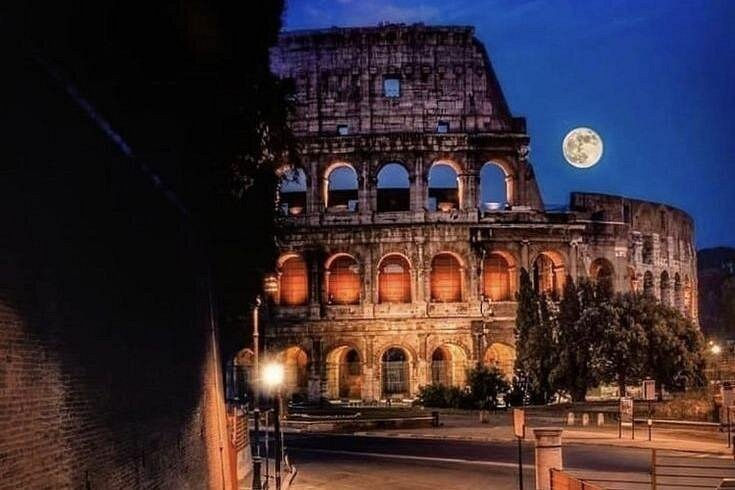
Starting around 7 p.m., this catches Rome in golden hour and carries you into full darkness, which is a genuinely different city, the Colosseum lit at night is a distinct experience from the Colosseum at noon, and the crowds thin dramatically. The route passes the Colosseum with a stop to get out for photos and a short talk, then Piazza Navona, the Pantheon, the Trevi Fountain, and the Spanish Steps, with the exact sequence flexible based on traffic and your preferences. Group size caps at fifteen travelers, and pickup may be scheduled up to twenty minutes before your listed start time, with exact details confirmed within twenty-four hours. Reviewers repeatedly mention guides adding an unscheduled gelato stop, which appears to be something of a house tradition.
At $69.22 this is less than half the private daytime tour, and for travelers who want the golf cart experience primarily for comfort and photos rather than accessibility, it's the better buy. The important distinction: unlike the Turtle Tours daytime product, this tour is not wheelchair accessible. Infants must sit on laps. If accessibility is the reason you're considering a golf cart, book the daytime private tour instead. As with the daytime tour, no monument interiors are included, everything here is exterior and pass-by.
How to Sequence These Into a Rome Itinerary
The Three-Day Structure I Use
Day one - orientation. Arrive, check in, and take the night golf cart tour after dinner. You see the major landmarks lit, you learn the geography, and you do it sitting down after a travel day. It's the single best use of a jet-lagged first evening I've found.
Day two - Ancient Rome. Book the earliest available Colosseum, Forum, and Palatine Hill slot to beat both the heat and the crowds. Eat lunch near Monti afterward, rest through the hottest part of the afternoon, and finish with the Trastevere food tour in the evening.
Day three - Vatican. Morning Vatican Museums, Sistine Chapel, and St. Peter's tour, avoiding Wednesday. The afternoon is deliberately unstructured, after three hours in the Museums, most people are finished, and this is when you want the Pantheon, Piazza Navona, and gelato at your own pace.
Day four or five, if you have it. Pompeii and Herculaneum if you want the archaeology and can spare the full day, or the Appian Way and catacombs if you'd rather stay closer and keep your evening. If you're traveling with kids, swap either for the cooking class.
Heat-Smart Sequencing for June Through August
Rome in high summer is not a city you can brute-force. Reviewers across every tour on this list mention July temperatures in the high nineties to 101°F, and the tours that consistently earn praise are the ones that manage it, guides who route through shade, air-conditioned transport, underground sites. Structure your days accordingly:
Before 10 a.m. - outdoor archaeological sites (Colosseum, Forum, Palatine)
11 a.m. to 4 p.m. - indoor or underground (cooking class, catacombs, Vatican Museums, long lunch)
After 5 p.m. - golf cart tours, food tours, walking the historic center
Always - a refillable water bottle; Rome's public nasoni fountains run cold and free throughout the city
Accessibility at a Glance
Fully accessible - wheelchair and stroller:
Trastevere Twilight Food Tour
Rome 3 in 1 Cooking Class (infant seats available)
Private Daytime Golf Cart Tour (infant seats available)
Not wheelchair accessible:
All three Colosseum, Forum, and Palatine Hill tours
Vatican Museums, Sistine Chapel & St Peter's Basilica
Catacombs, Aqueducts & Appian Way
Pompeii & Herculaneum (also not recommended for visually impaired guests without a dedicated assistant)
Night Golf Cart Tour
Traveling With a Dog
None of these ten tours permit pets. Every one of them involves either a ticketed archaeological site, a museum, or food service venues where animals aren't allowed. If you're bringing a dog to Rome, you'll want to build a separate track of outdoor, non-ticketed activities, the Villa Borghese gardens, the Aventine Hill and its orange garden, the Trastevere streets, and Testaccio market area all work well, and many Roman cafés with outdoor seating are relaxed about well-behaved dogs. I'm happy to put together a dog-friendly parallel itinerary for anyone who needs one.
Frequently Asked Questions
Do Rome tours include entrance tickets? It varies, and it's the first thing to check. All three Colosseum tours, the Vatican tour, the catacombs tour, and the Pompeii tour include admission. Neither golf cart tour includes any monument entry, those are sightseeing and exterior stops only.
How far in advance should I book Rome tours? Use the booking-window list above as your guide. Practically speaking: arena floor access three months out, food tours and Vatican two months out, everything else six to eight weeks. In July and August, add two weeks to all of it.
What's the best month to visit Rome? Late April through early June, and late September through October. You get manageable temperatures and long daylight without the peak-summer crowds and heat. July and August are entirely doable, just build the itinerary around the heat rather than fighting it.
Is the Colosseum arena floor worth the upgrade? For most first-time visitors, no. The premium is meaningful, the cancellation window is the strictest on this list, and there's a documented pattern of the arena floor portion being substituted. For repeat visitors and serious history enthusiasts who accept that risk, it's a genuinely unique access point.
Can I do Pompeii and Rome in the same trip? Yes, if you have at least five nights in Rome. It's an eleven-hour day from Rome and it will cost you the following morning too. On a three-night trip, I'd skip it.
Do I need to bring my passport to the Colosseum? Yes. Every guest, including children, must present government-issued ID matching the name submitted at booking. No ID means no entry and no refund.
Are Rome food tours suitable for picky eaters or kids? The Trastevere tour welcomes children, under four join free without food, and paid food tickets are available from age four. The menu leans heavily toward pizza, porchetta, fried rice balls, pasta, and gelato, which is friendlier to cautious eaters than most food tours. For very picky eaters, the cooking class may be the better fit since you're making the food yourself.
Work With a Travel Advisor - At No Cost to You
Everything above is bookable on your own, and if you'd rather do that, I hope this guide saves you some time and a few mistakes. But if you'd like someone to build the whole thing, the hotel, the sequencing, the tours in the right order on the right days, with the Wednesday Vatican problem and the Colosseum name rule already handled, that's what I do, and my planning services are free to my clients. I'm compensated by hotels and suppliers, not by travelers, and there are no planning fees.
If Rome is on your list for 2027, reach out and let's talk through what you're imagining.
Pricing reflects starting per-person rates at time of writing and fluctuates by date, group size, and season. Tour operators occasionally revise itineraries and policies, always confirm details at the time of booking.
Disclosure: Some links in this post are affiliate links. If you book through them, I may earn a small commission at no extra cost to you. I only recommend tours I've personally researched and believe are worth booking.


Comments